

julekaffe - pb gathaithi - kenya - washed
julekaffe - pb gathaithi - kenya - washed
couldn't load pickup availability
Ayae Maki Fredheim is originally from Japan. She moved to Norway with her husband in 2013. That is when she discovered her love for coffee and her passion for roasting started blossoming. Aya started as a barista at a café in Oslo in 2014, began roasting in 2018, and became the head roaster in 2019. She remained in that role until 2023 when her son was born. Motherhood has a certain way about empowering women to follow their dreams. Aya started her own roastery, and after months of planning, she officially launched Hibi Kaffe in November 2024.
Hibi means daily in Japanese—better coffee for your everyday moments. Basically. Aya says: "Starting this journey has been amazing, and I’m so excited to share it with others!" Equally amazing is the way that our paths crossed and that was a pure coincidence triggered by our common interest in sourdough baking, and Aya and Leif's hevet.no collection of proofing baskets.
Hibi beans now come in a new bag that is Aya's effort to decrease plastic use in what is the standard in specialty coffee packaging. The outside of the coffee bags is now made of rice paper (isn't that cool!) and they look impeccable, too.
This washed Kenyan peaberry is complex and juicy. It has a lively acidity, like dried goji berry and blackcurrant, and finishes like oolong tea. It makes for s a great choice for filter brewing, and as Hibi’s Christmas coffee it is perfect for slow, cozy winter mornings.
harvest: Gathaithi Factory is run by the Gathaithi Farmer’s Cooperative Society. About 1,600 smallholder farmers deliver their cherries there, and each one tends a small plot of roughly 100 to 250 trees.
Most of the trees are SL varieties, with some Ruiru 11. Many of the farmers also grow bananas and maize alongside their coffee.
origin: Gathaithi Factory, Nyeri, Central Kenya
varietal: SL-28, SL-34, Batian, Ruiru 11
altitude: 1450 masl
The farmers compost the cherry pulp with manure and use it to feed their plots.
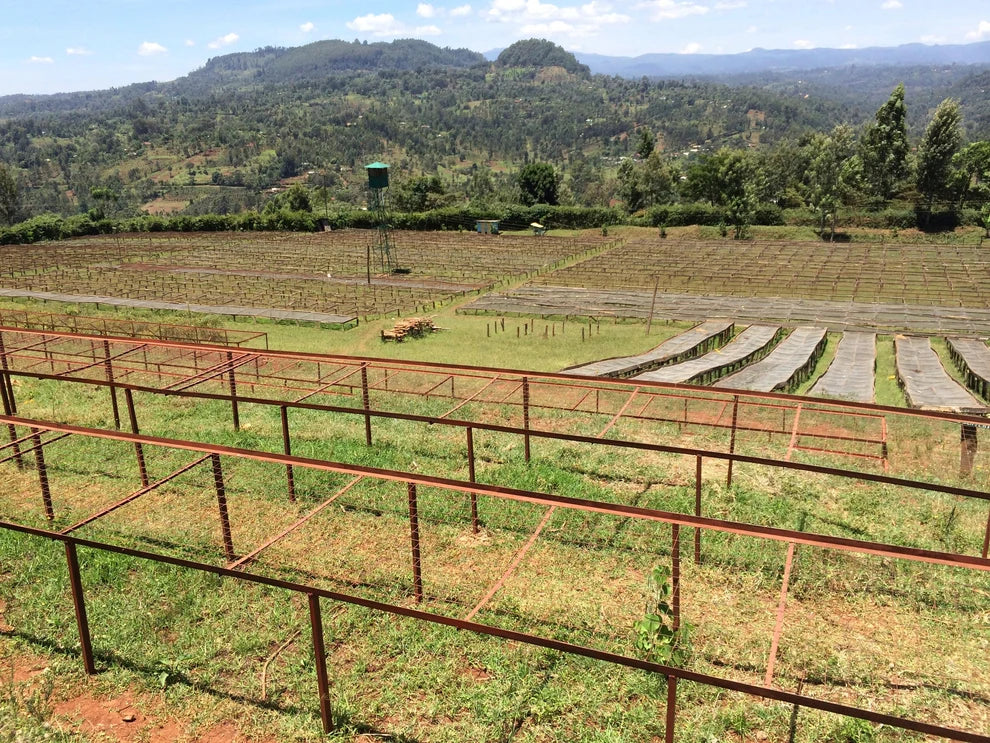
processing: The farmers sort the cherries by hand before pulping, and the coffee is graded by density. The better grades ferment for 16 to 24 hours. They are then washed, graded again in channels and soaked in clean stream water. Finally, the coffee dries on raised African beds for up to three weeks, covered at midday and overnight.