

kelloo lalesa - ethiopia - washed
kelloo lalesa - ethiopia - washed
couldn't load pickup availability
Ayae Maki Fredheim is originally from Japan. She moved to Norway with her husband in 2013. That is when she discovered her love for coffee and her passion for roasting started blossoming. Aya started as a barista at a café in Oslo in 2014, began roasting in 2018, and became the head roaster in 2019. She remained in that role until 2023 when her son was born. Motherhood has a certain way about empowering women to follow their dreams. Aya started her own roastery, and after months of planning, she officially launched Hibi Kaffe in November 2024.
Hibi means daily in Japanese—better coffee for your everyday moments. Basically. Aya says: "Starting this journey has been amazing, and I’m so excited to share it with others!" Equally amazing is the way that our paths crossed and that was a pure coincidence triggered by our common interest in sourdough baking, and Aya and Leif's hevet.no collection of proofing baskets.
This complex washed Ethiopian comes from the region of Lalesa, one of the finest coffee-producing areas in Gedeb, known for its dense, layered semi-forest vegetation. Enjoy fruity notes like peach, a black tea-like character, and a lemony finish.
Made up of cherries delivered by local farmers, this coffee is processed at the Alemayehu Tilahun Washing Station in Lalesa, Gedeo. Alemayehu, a native to the Gedeo Zone, has been working with coffee for almost 20 years. He built his wet mill in 2018, with the hope of purchasing red cherries exclusively from the nearby farmers of Lalesa. He attributes his success to the relationships he has cultivated within the community & farmers surrounding his washing station.
harvest: The cherries are collected manually and hand sorted later. They are placed directly in the hopper that is connected to the pulping machine (a traditional Agaarde Disc Pulper). The coffee flows from the hopper down to the pulper, and the pulper removes the skin and pulp. The machine is designed to conduct grading of high and low quality (1st and 2nd), based on density.
The coffee is then fermented under water in tanks for an average of 72 hours, but any time frame between 48 - 100 hours is within the norm. The coffee is graded again in channels, so that the cherries of lower quality (with a lower density) will float. They are removed, leaving the denser, higher quality beans to be separated as higher-grade lots.
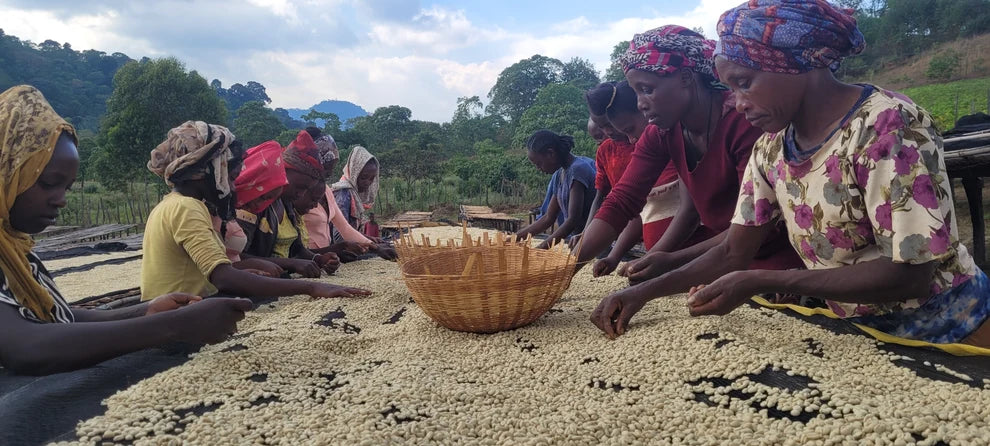
The parchment is soaked in clean water and then dried on raised beds for approximately 8 - 20 days. The coffee is dried in layers of 2-8 cm, depending on the climate, the type of tables, and the stage of drying.
origin: Gedeb - Lalesa
processing: washed
varietal: heirloom
altitude: 2150 masl